







Safety Instructions
These safety instructions are to be observed when handling the battery. When working on the battery, start by reading the vehicle's operating manual and follow the guidelines it sets out. Keep these safety instructions with the vehicle's operating manual.
First aid:
If acid comes into contact with the eyes, rinse for several minutes with clear water before seeking immediate medical attention. If acid is swallowed, consult a doctor immediately. Should acid get on skin or clothing, neutralize straight away using soapsuds or an acid neutralizer and then rinse thoroughly with water and get immediate medical advice or attention if there is a possibility of burn injury.
1. Removal from and installation in the vehicle
- NB: interruptions to the power supply may cause electrical devices, (e.g. immobilizer, radio etc.) to malfunction.
- Only install batteries that have been sufficiently charged, i.e. with a minimum terminal Voltage of 12.5V.
- Switch off the engine and all electrical devices before removing the battery.
- When removing the battery, disconnect the negative terminal (-) before the positive terminal (+).
- Clean the installation area in the vehicle before fitting the new battery.
- Clean the battery terminals and terminal connectors, treat the terminals with suitable grease.
- Use the original attachment parts. Firmly secure the battery.
- Wait until you are connecting the battery within the vehicle before removing the protective caps. Attach these to the terminals of the battery being replaced to prevent short circuits and sparks.
- When installing the new battery, connect the positive terminal (+) before the negative terminal (-). Ensure the terminal connectors are securely in place.
- Take parts such as terminal covers, the elbow, the hose connector and the terminal clamp holder from the previous battery and connect as before. Do not block gas outlets during usage of transport.
2. External Charging
- Only use suitable direct current chargers and observe their operating Instructions. Never charge frozen batteries or those with a temperature above 45°C.
- Connect the positive terminal of the battery (+) to the positive terminal of the charger, and the negative terminal of the battery (-) to the negative terminal of the charger. Only switch on the charger once the battery has been connected.
- Only switch off the charger once the battery has finished charging.
- Stop charging If the battery becomes hot or if acid leaks out!
- Ensure charging takes place in a well-ventilated area.
3. Maintenance
- Keep the surface of the battery clean and dry, and only clean with a damp or anti-static cloth.
- Protect the terminals and connectors from corrosion and treat with acid-free grease.
- Do not open batteries where the caps are totally sealed!
- If cold start performance is insufficient, check the battery and, if necessary, recharge.
- Stored batteries should always be kept charged and cool.
- Check the state of charge on a regular basis. If the terminal voltage falls below 12.4V, recharge the battery.
4. Jump-starting (only for automotive SLI batteries)
- Read the vehicle’s operating manual and follow its instructions on jump-starting.
- Jump-starting can only be performed using a battery with the same nominal voltage. Both batteries should also be roughly the same size.
- Only use approved jumper cables (e.g. in accordance with ISO 6722).
- Observe the jumper cables operating instructions.
5. Battery disposal
- As a consumer, you have a legal obligation to return used batteries. You can hand in your batteries for free to wherever the batteries were purchased or to the public collection points in your city or community.
- Do not dispose of batteries with household waste.
- Please use any existing system in your local area when returning used batteries.
- Please only hand in discharged batteries.
- Batteries are generally discharged when the equipment operated with them switches off or indicates “battery empty” or the battery no longer functions correctly after an extended period in use.
- To prevent short circuits, cover the battery contacts with adhesive strip.
Battery Safety Symbols

Take note of the information on the battery, the instructions for use and the operating instructions of the vehicle.

Wear eye protection.

Keep children away from acid and batteries.

Explosion danger:
- A highly explosive oxyhydrogen gas is emitted during battery charging therefore:

No naked flames, sparks, naked lights or smoking:
- Avoid sparking when handling cables and electronic devices.
- Avoid short circuits.

Chemical burns danger:
- Acid is highly caustic therefore:
- Wear gloves and eye protection.
- Do not tilt the battery, as acid could spill out from the degassing vents.

First Aid:
- If acid splashes into the eyes rinse immediately with clear water for several minutes. Then consult a physician.
- If acid splashes onto the skin or clothes neutralise immediately by using an alkaline solution or soap and rinse with large amounts of water.
- If acid is swallowed consult a physician immediately.

Warning:
- Do not expose batteries to direct sunlight without protection.
- Always store batteries in a frost-free area, as discharged batteries can freeze.

Disposal:
- Hand in used batteries at a collection centre. During transportation take note of the instructions contained in Item.
- Never dispose of old batteries with domestic waste.
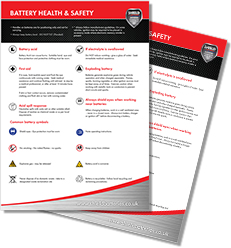
Battery Health & Safety PDF to Download